A 3/5-stage Clos fabric, Mist-managed microsegmentation, and identity-aware Access Assurance, the Zero Trust architecture that catalysed a measurable shift in clinical-grade security.

Executive Summary
A regional healthcare group operating four hospitals and twenty-two outpatient clinics across the GCC faced a quietly growing risk: a flat internal network that gave any compromised device a direct path to electronic medical records, imaging systems, and connected medical equipment. By partnering with Mindware to deploy a Juniper-based Zero Trust architecture, anchored by a 3/5-stage Clos fabric, Mist-managed microsegmentation, and Access Assurance, the group moved decisively from a perimeter-centric model to a verified-everywhere posture in seven months. Lateral-movement risk was cut dramatically, and the IT team is now positioned to support clinical innovation rather than firefight network alerts.
The Challenge
Healthcare is the fastest-growing segment of the MEA AI and cybersecurity market, 23.62% CAGR through 2031, and the threat surface has expanded faster than most defences. For this group, the immediate trigger was a third-party assessment that surfaced an uncomfortable reality: once an attacker reached any device on the corporate network, virtually every clinical system was reachable. The legacy architecture had been built for performance, not for assumed-breach containment in a connected-clinical environment.
Three operational realities made the existing posture untenable:
“We were protecting twenty-first-century clinical operations on a network architecture designed for an earlier era. Compliance was the trigger, but patient safety was the real motivation.”
The Solution
Mindware worked alongside the group’s clinical IT, security, and network engineering teams to design and deliver an integrated Zero Trust architecture, anchored by three components from the Mindware portfolio:
The rollout was sequenced to protect clinical operations, first the central data centre and its Clos fabric, then the flagship hospital, then the remaining hospitals and clinics in waves of three. Total programme duration: seven months, with zero impact to patient-facing services and full clinical-team enablement at every site.
Why this combination
Juniper’s Mist-managed network and Access Assurance bring switching, wireless, and identity-aware NAC under one cloud-delivered policy plane, a critical simplification for a lean IT team supporting clinical workflows around the clock. The 3/5-stage Clos fabric gave the architecture the structural integrity it needed. One Identity Safeguard closed the privileged-access loop. Together, they form an integrated solution that does exactly what Zero Trust requires: verify explicitly, enforce least privilege, assume breach.
The Results
Within twelve weeks of full deployment, the healthcare group could measure what a Zero Trust architecture actually delivers in a connected-clinical environment:
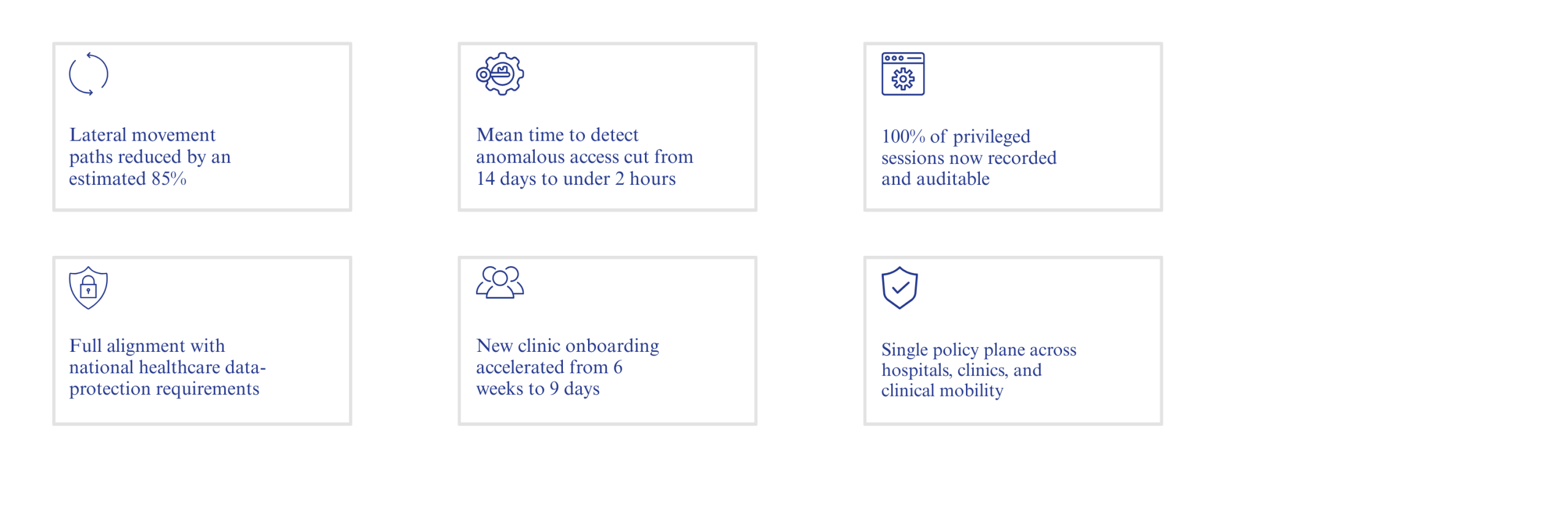
Beyond the metrics, the operational difference is qualitative. The IT team no longer triages thousands of low-signal alerts from disconnected tools. Network and security policy live in one place. Medical IoT devices are no longer invisible and no longer trusted by default, they are identified, isolated, and observed. And the group can demonstrate, to regulators, to its board, and to the patients it serves, a security posture built for the next decade of digital health, not retrofitted from the last.
Why Mindware
This programme succeeded because the technology was matched to the group’s clinical operating reality, a lean IT team, twenty-four-seven patient care obligations, and a regulator watching closely. Mindware’s role went beyond technology distribution. Working with our channel partners, we co-designed the Clos fabric, sequenced the rollout to protect clinical services, and ran enablement sessions so the group’s engineers could operate the Mist-managed estate independently from day one.
That is what catalysing digital transformation looks like in practice: long-term, human-centric partnerships that turn integrated solutions into measurable outcomes, and, in healthcare, into better protection for the patients and clinicians who depend on the network every minute of every day.

Mindware’s security specialists work with healthcare groups across the MEA region to design Zero Trust architectures aligned to regulatory frameworks, clinical workflows, and operational reality. Let’s shape what comes next.
